Showing posts with label Section 24. Show all posts

Friday, April 29, 2011

Section 24 Completed

I am slowly getting over this flu and I was able to fool around yesterday for half an hour and today a little bit to complete section 24, the rollbar story.
Yesterday I just clecoed on the rollbar and its supporting structure to see if for one the rollbar would still slide over the bases and second to see if the overall fit was still satisfactory. Both questions were answered positively.


When priming the bases I remembered the inherent roughness of the green Cortec primer that I had used on the inside of the rollbar. So for the bases I didn't feel it was a good idea to use Cortec again as it might have made that sliding-over part very hard to accomplish. Instead I wanted a primer providing a slicker surface which the Napa 7220 stuff is definitely good for. That's why you might have noticed the bases in previous pictures to be grey in color after the priming.
I don't know if this was the reason why it all worked out well but I was definitely able to slide the rollbar over the bases without any help.

Then, today, I riveted all the parts together that were just clecoed yesterday. It wasn't much of a problem except for a lot of manual labor with the CQR (Close Quarter Riveter) as I refused to rivet the aft part of the brace to the aft bulkhead from the easy side. This would have been from the tailcone side which could have been done with the pneumatic riveter all along but then exposing the ugly warts of the shop head on the inside whre they'd been visible. Instead I riveted from the cabin side and that was a bit awkward to say the least.
Anyway, now that it's completed this will soon be forgotten. Enjoy the nice shots ...


Monday, April 25, 2011

Rollbar Painted - The Sequel

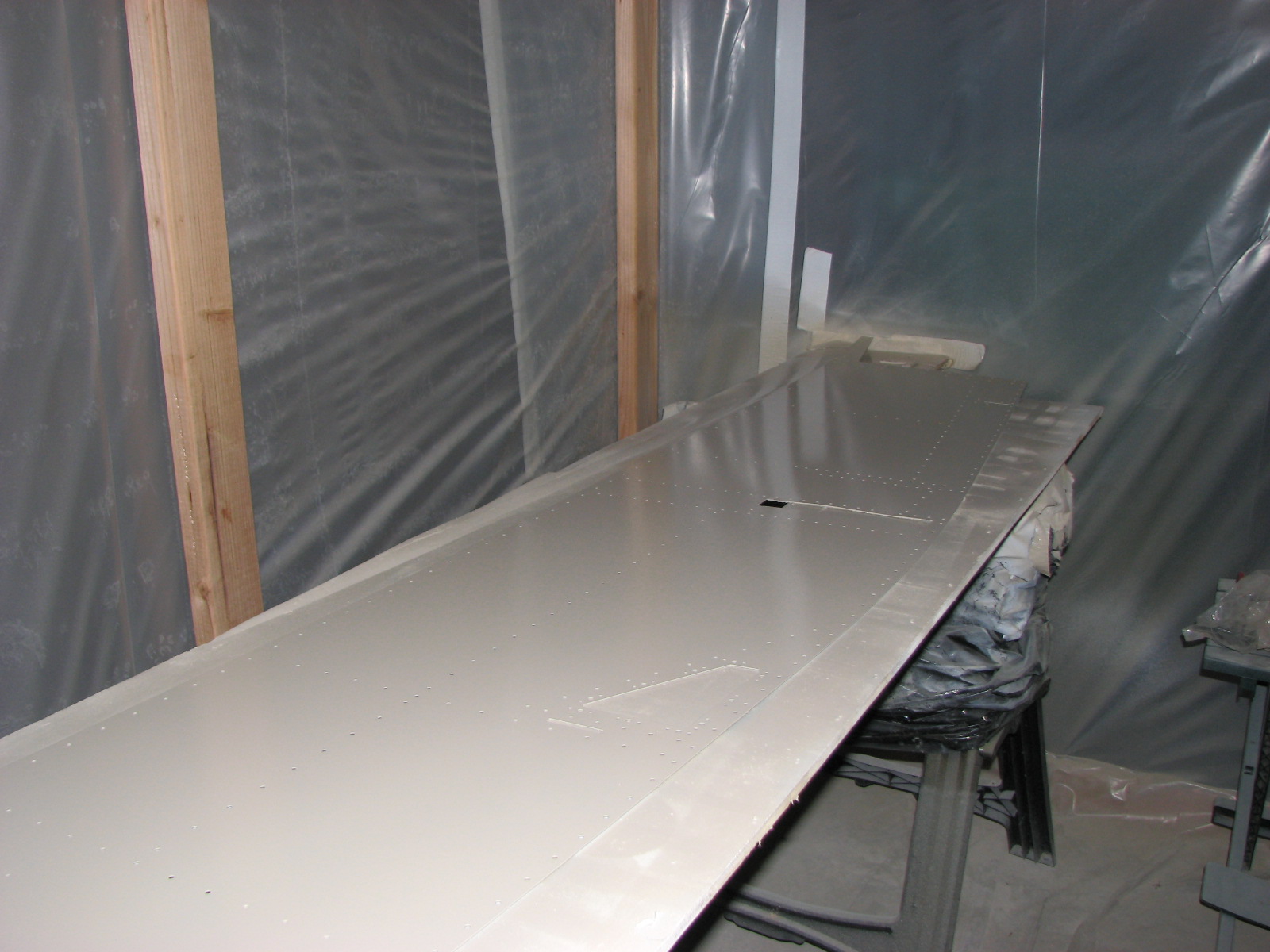
Despite me developing a full blow flu (in this temperature, go figure!) I was able to spray the other side of the rollbar and the reading light brace. The job turned out very nice again.


The scale has absolutely no meaning to this picture and shouldn't even be there. Please ignore it.

While I was feeling a bit better and waiting for the paint to cure I worked a little around the fuse, mixed some Pro-Seal and put the upper firewall onto the fuselage. I also match-drilled the little stub pieces of piano hinge and riveted them into place. I hope everyone at this step realizes that the upper screw hole for the nutplate that gets half riveted to the firewall and half to the side skin has to be dimpled for a #8 screw. If you riveted the stub hinges in place without doing this it's either drilling those rivets out again or dimpling the hard way by forcing the screw in. Not sure you like the looks of the later in such a prominent area.


The last thing I did before the flu took the best of me was to rivet the little diagonal stiffeners onto the side skin from the front inside area.


I took the photos tonight as I was just too exhausted this afternoon to do anything but lying down.

The next steps are messy and require firewall sealant to get spread around to seal off the cabin from possible fumes in front of the firewall. In my current condition I better hold off on that one until I feel better.
Maybe I can do some light riveting job with the rollbar while I'm forced to be at home...

Sunday, April 24, 2011

Rollbar Painted Part 1

Early in the morning I prepared the parts for painting. The primer had dried nicely and the surfaces were quite smooth. To remove minor imperfections I sanded them with a maroon SB pad and then started the painting. Paint use anticipation was dead on and while the parts were curing I worked on section 29.
Most of the dimpling of that strip that goes on top of the FW I had done yesterday so now it was to rivet the nutplates and the strip in place. That went relatively easy although slow. A lot of care had to be taken to get those rivets in and the overlapping skins flat. Some of these needed the screw to go into the nutplate to hold everything down and in place.


Then the piano hinges for the cowl had to be match drilled. If you haven't cut them to length yet, make a note for 1201J, the longer one of the two hinges. The manual asks for it to be cut to 25.5" length. That is incorrect. It needs to be 26" long with the loop starting on the lower left side of the FW and that flat side in that little cutout area where the hinge pin ends will be stored.
How I know? Look at this:


I had to drill an extra holes to rivet down the end of the piano hinge and will have to fill the unused hole with a rivet.I believe the page where this incorrect length was mentioned had a revision number. Stuff like that just makes me angry. The drawing is incorrect either as it shows two loops on each end which is not would you need to do here to get the hinge over that hole.

After match-drilling and the deburring the holes had to get countersunk for AD3 rivets.


And then the hinges were riveted in.


And finally the rest of the vertically mounted nutplates were riveted in and the antenna platform was riveted on.


Then it was time to get the parts out of the paint booth and put them in the shop for the night.


They turned out nice, tomorrow the opposite side will get painted.

Saturday, April 23, 2011

Lots of Invisible Things

That's what I did today. Despite a cold I developed just after the end of the work week yesterday, I spent a lot of hours in the shop today. You can hardly see what I did. Among the more visible things is the priming for the paint job coming up tomorrow morning. Then I screwed and torqued the rollbar bases back on and lacquer sealed them. I also prepared a lot of parts in the forward upper fuselage section 29, so I can work on that while waiting for the paint to cure tomorrow.
Dimpled the upper firewall and the little aluminum strip that will hold the cowl hinges, countersunk the nutplate attach holes, deburred everything and pulled additional parts that will need surface treatment and priming.
No photos, sorry. More tomorrow.

Friday, April 22, 2011

Rollbar Removed

I cleaned the fuselage from chips from yesterday, removed the brace to allow the rollbar to be removed, which I did as well and it went fairly easy. I am confident at this time that I'll get it back on without too much of a hassle.
I did some supplemental riveting for section 24. Riveted the nutplates in, added the rest of the LP3-3 rivets to complete connecting the angles, bulkheads and floors together.


I also removed the bases and marked them left and right by filing a mark into both of them indicating which side they have to go on. Deburred everything and stacked up the parts that need surface treatment and primer next.


Oh, and I also countersunk the last outside holes in the rollbar and the top attach holes in the rollbar brace that will have contact with the Lexan glass eventually.

Tomorrow, I try to do the surface prep in the morning and also prime a little later in the day, so I could paint on Sunday. Let's see how it plays out.

Thursday, April 21, 2011

Rollbar Match-Drilled

Don from Texas had brought up a very good idea for the match-drilling of the rollbar. He suggested to hold off on that until the rest of the structure it connects to through the center rollbar brace has been put in place. That way you are sure that the alignment of the rollbar is correct. Apparently, a lot of builders found out later that the rollbar had to be pulled back a little to match the rest and that's a bit hard to do when you already riveted it to the bases at some defined angle.
I thought that was a great idea and so I did not start with drilling today but by putting the aft area of the fuselage into place. In order to do that I had to rip open the sealed off tailcone as two parts of the aft bulkhead were needed to match drill a little bracket tab in the front of the tailcone.


I was very pleased to find nothing in there that wasn't supposed to be in there. The seal had worked well it appears. Unfortunately, the 3M cream painter's tap eI had used when running out of blue tape had deteriorated tremendously over the time and did not want to come off clean. I had a very hard time even with MEK to remove the residues from the aluminum. Lesson learned, never use the creamy tape again. It's 3M but some nasty crap anyway.

After this cleaning session I fitted the bulkheads onto the fuselage. The little cutout for the longerons are very tight and I used a hand deburring tool to shave off tiny layers of metal in that cutout until it easily slid onto the longerons.


By the way, see that perfect fit? Not just the cutout, I mean how nicely the flange follows the side skin? Well, there's an ominous request on page 24-05, I believe, that asks for fluting the 3 flange segments below the cutout on both bulkheads until the holes in the flange mate the ones in the side skin. I found that weird from the start as the side skins are pretty much flat in that area and so are the flanges. You usually have to flute when something follows some kind of arch.
So I did nothing and just clecoed this one in place to see if there was some fluting required. I didn't see the slightest hint to do anything on either side. Do you?


Maybe Van's did it at the factory. When you look very closely you can see a little dent in the middle of the middle flange. I didn't do that. So maybe this step is not required anymore, just like the one that suggested you should separate the bulkheads from one initial piece. That step was obsolete either as Van's had already done it for us.

Anyway, I clecoed the aft part of the structure together and put the rollbar brace on top. This is how it looked without changing anything about the alignment of the rollbar.


A little closer and taken from the plane of the aft bulkhead...


...reveals that this is pretty straight and doesn't look like it needs any adjustments.

I tried to wiggle it around but the rollbar wouldn't want to move at all, so I figured that this is perfectly aligned and I went ahead and drilled the bases.


The inner holes were a little odd to get at but it was manageable through the opening in the aft bulkhead.
Well, that concluded the day. It was already past 9pm when I took that photo and I left the cleanup of the chips for tomorrow or whenever the next session is going to be.

Wednesday, April 20, 2011

Rollbar Riveted

From the three options I discussed yesterday I chose the one that I least liked. Why? It's the only one that ensures that the rollbar would be maintaining its structure when taking off and allow me to paint the part separately before putting it back on for final installation.
It was a little awkward to rivet the rollbar while on the fuselage and some of the rivets were hard to get at (mainly because the workbench is now too high) but I managed and prepared everything for the match-drilling happening tomorrow evening.


In clecoed the struts on to push the rollbar back a bit and hold it in the correct position for match-drilling (I hope so at least).
I also took the parts I painted yesterday out of the paint booth and removed leftover spray dust. They turned out pretty nice.


Tomorrow's a gusty, breezy day again and so I covered the whole fuselage with a tarp in an attempt - probably futile - to keep the dust out.

Tuesday, April 19, 2011

Rollbar Continued

I didn't know how to describe the progress from today as it partly depends on how I am going to continue tomorrow evening. When I came home I started doing some supplementary jobs while waiting for my wife to come home to help me with the rollbar.
Among those jobs was a little counter sinking and nutplate riveting on the bracket that will hold the fuel tank in place as well as dimpling all the nutplate attach holes of the aft bulkhead that will close up the tailcone to the fuselage. Forgot to take a photo there but it's not that big of a task, is it.

I also started spraying the parts for the oil reservoir and the battery and the little platform for the GPS antenna with engine enamel.

Then when my wife came home, we immediately started working on sliding the aft half of the rollbar onto the bases again. That went pretty well as we had done it yesterday as a trial run. The next step was to now take the front half and get this one on as well. That was a bit more tricky - as expected, but we managed to finally get it on with a little tweaking and pushing.


Everything was clecoed into place and now the big question is how to continue?

I could rivet half of the holes inside and out and leave the rest clecoed before match-drilling, or I could rivet all of it and hope that I somehow will be able to get it off for deburring and then back on, or I could fill the rest of the holes with clecos as well, delay the riveting and match-drill now. The big advantage of the latter would be that if there was any trouble sliding it off or back on, I could take the clecos out and just do it like we did tonight. I'm afraid that the riveting will put so much tension on the bases that I might be able to get the rollbar off but maybe not so easily back on.
The structure just clecoed as it is in the photo above is very rigid, stiff and strong, so I'm not worried about the match-drilling being off if I just held it together with clecos.
So I lean towards that no-rivet option right now. Any comments from the educated crowd?

While I was thinking about the best way to do this I kept my hands busy by trial fitting those little struts that will go in front of the rollbar and connect it to the canopy deck. Looks like the fit is pretty good.


It was getting late, so I turned the previously sprayed parts over and sprayed the other side for the parts to completely dry over night. I peeked through "door" of the paint booth to take this sneak peak shot.


My favorite color red was out of stock ...

Addendum: Thinking about my thoughts from last night again I found a problem with them this morning. While it might be better to not rivet the structure before match-drilling for easier removal, it doesn't really help at all when painting it. My intention was to paint it before final installation and riveting it to the base blocks. Without rivets in them this is not going to be doable. I'll have to think more about this ...

Monday, April 18, 2011

Rollbar Fitted

Tonight I just briefly worked on the plane after coming home very late. All I did was to install the rollbar bases (keeping the bolts loose) and slide the aft rollbar that had the strips riveted to it over the bases and see if they would fit. They did fit indeed. I was quite amazed that they even slid on quite easily as I was expecting much more resistance or misalignment.
I won't get sloppy now but this is at least a good sign I guess. Tomorrow evening with the help of my wife I hope be able to put both halves on and start the final riveting process on the roll bar (continuously checking that I can still slide the thing on and off the bases. Once that is done, I can match-drill the rivet holes into the sides of the base blocks and then prime the bases as well as paint the rollbar.

Sunday, April 17, 2011

Section 23 Completed

Finally, after almost 70 hours of work, the exhausting section 23 has been completed today!
It started with the installation of the air sickness detectors or air vents as they are usually called. Check Dave's blog if you don't understand why they are also called air sickness detectors. I found that a much more precise term than air vents.


This required some match-drilling. Right side clecoed and ready for the drill bit.
Nothing really fancy about this step only that I had some trouble with the final installation of the vent doors because I didn't precisely remove the material Van's had asked for and so the doors wouldn't fully close due to some interference. It was much more time consuming to remove the material now that the door had been riveted together from its various parts but I managed and so eventually the vent doors were installed.


Then the last step was at hand, installing the piano hinges that will eventually hold the lower cowling to the fuselage. This again required some mach drilling and also some priming of a spacer that sits under the hinge.
This was all quickly thrown together and riveted on, so all you get is the photo when it was completed.


And this completed section 23. Horray!

It was around noon and getting real hot (95F today) but it was too early to call it a day, so I went inside the shop, turned that great A/C on and closed the door.
I wanted to continue on section 24, which is the rollbar installation. The parts were already primed on the inside but I hadn't riveted them together yet because I read in other blogs and in the forum that people had issues following the plans order. It seems that the fit of the rollbar is pretty tight and it is very hard to slide the completed rollbar onto the base pieces on the fuselage. My plan was to complete part of the riveting off the fuselage but leave the two halves separated for now. Try a test fit on the bases and then rivet the parts together while they are already clecoed to the bases. My hope is that by doing that I won't have an issue trying to slide it over the bases afterwards.

So, I started by riveting together the two sides of each half.


And then added the inner strips to the aft half.


That was quickly riveted.


While at it I also added the modifications for the little "reading" light that will get attached to the front rollbar. I also drilled the holes for the wire into the flange of the aft rollbar and put the snap bushing in. I didn't feel like trimming the flange (and ruin the looks) and so I ended up using clear silicone RTV on the inside of the flange to glue the snap bushing in. The side of the hole is so deep that the snap bushing wouldn't snap in without being recessed - or glued in)


The final step was then to open up a pilot hole to 3/8" in the right rollbar attach plate on the fuselage to accept another snap bushing for the wiring. This one can get drilled wider from below and allo wthe snap bushing to get properly seated.


And that concluded another busy weekend.

Friday, April 8, 2011

Side Skins Painted

So I rushed home after work to spray paint at a good temperature of around 75F. I mixed a little bit too much paint but this better than running short like last time.
Here are the first shots about 45 minutes after painting. The skins and some additional stuff are still sitting in the paint booth. Temperature is now falling quickly with the cold front moving in and when we got down to 68F I had to do something. Well, I put the space heater in the booth which is safe as the Stewart paint is not flammable.


Later tonight when the paint is dry to the touch I'll probably move the parts into the shop and heat the area there. Might keep the temperature better than 4mil plastic ...

Update:
I did remove the parts from the paint booth and put them all in the shop for overnight heated curing. Looks pretty nice, I think I am getting better with the paint gun.

Thursday, April 7, 2011

Paint Primer Shot

Change of plans. The weather forecast looks seriously bad for the weekend for shooting paint as the max temps will be close or below the minimum of 65F. This might be considered warm in Ohio this time of the year but we will drop from 80F because of a storm system that's moving through. To make sure I can shot some paint tomorrow evening, I made sure today I got primer applied to all the parts that need painting.


See the rollbar unprimed? I thought about this for quite some time and then decided to hold off on priming the separate parts for now. I think it will look much better if I assemble the thing first and then prime and paint right before riveting it to the rollbar blocks that will hold the thing on the fuselage.
I also primed the side skins but I never took out of the paint booth or dared to open up the entry as the wind was blowing a lot of dirt around today. So all I can show you is an pressurized paint booth and you have to take my word for it that it contains two primed and drying side skins.


I also got the main brake lines installed. Once I had enough length for the two lines it was a piece of cake to finish this part of section 27. I won't finish this section before I finished the wiring as part of the Finish Kit as the pedals would be in the way.

Ready for connection to the brake cylinders.

Filling up the void in the center tunnel. The last slot in there has to be filled by wires.

Waiting for the landing gear and the brake installation.

Wednesday, April 6, 2011

Rollbar Primed Inside

After a long time I got to spray Cortec 373 green again. I almost forgot what a great product this is. Now spraying it with my latest HF gun I had even more fun watching how nice and smooth it was laying a green tint on the aluminum. Great stuff indeed. Two coats and done.
I sprayed more parts than are visible in the following picture but I had just finished spraying and I didn't want to move the part into the shop yet. In fact I think I'm letting it sit in the paint booth over night as the Cortec stuff doesn't mind lower temperatures.


The inside of the rollbar is completely primed and on Friday I will spray the white primer for painting. Saturday is out for painting as the forecast temperatures are below recommended level of application. Sunday should be workable though.

The next step on the rollbar would be to rivet the parts together and make the rollbar assembly. I will not do that as a lot of people on the forum had trouble following this order when they then wanted to put the rollbar on the attach blocks and match drill them. They needed a spreader to open up the tight fit before they could slide the rollbar on for that. Bill Hollifield came up with a much better and simpler approach that ensures proper fit and no headaches. You wait until you can loosely screw the rollbar attach blocks on the center bulkhead of the fuselage. The you cleco the rollbar parts onto the block and connect everything as it's supposed to be assembled. NOW, you rivet the rollbar together and ensure that it still fits perfectly on the attach blocks. You can then match drill them right there and finalize the assembly.

I also got my brake line from Van's in the mail and so I can finish section 27 on Saturday when it's too cold to spray paint.

Tuesday, April 5, 2011

Ready For Some Priming

I worked into the dark tonight to finish the last pieces of aluminum that needed some scrubbing. Now I ready for the priming session. Tomorrow I am planning to shoot some green and depending on how I can arrange things in the paint booth, I might also shoot some white primer. The green is just for corrosion protection while the white primer is to covered with paint.
If I can't do the white I'll do that on Thursday to be sure it had enough drying time before getting painted on Saturday.
Sunday looks like a day for flying if the wind dies down ....


Here's the stack piling up and waiting for some spray action.

Monday, April 4, 2011

Side Skins Prepped

After work I used the warm weather before sunset to scruff and prep the side skins and some additional parts that will soon get used. Sunset came a bit too early and I couldn't finish all the parts in my stack so I will finish the rest tomorrow evening.
The I will set up a corrosion primer session for Wednesday and a paint primer session for Thursday or Friday to be all ready for painting on the weekend.
No photos from tonight, sorry.

Sunday, April 3, 2011

Rollover Bar Ready for Priming

After hours of deburring and counter-sinking on the rollover bar the part is now ready for priming. I hope to do the surface prep during the week and get it ready for the big spraying session on the next weekend.
The bar seems to be perfect for painting after assembly, so I will just do the corrosion priming for now and assemble it before putting the paint primer on.

Saturday, April 2, 2011

A Lot of Different Things

Phew, that was a busy Saturday and we were getting close to a 100 F while I was working outside. Silly me!
I finished the short brake line hoses that get attached to the master cylinders. As I didn't pay too much attention to the brake line length that were requested thereafter I foolishly cut the short lines off of one 15' coil. MISTAKE! If you read this and haven't done this yet, make a mental note to revisit this page before getting yourself set back. The 15' coils that are provided are supposed to be used evenly. So if you cut off all the lines for the left brake of one coil and then all the lines for the right brake from the other it will work out fine. A little note in the instruction would have been nice ... Anyway, my order on another 9' of brake line is in and until then I'm just going to let it sit as I won't be able to finish it anyway.


To keep me busy, I then went ahead and made those cutout in the side skins to allow the wing spars to get through. I used the HF pneumatic nibbler for this, as well as a rough hand file and a 1" SB wheel (the cutout is supposed to be a bit less than an inch wide, but the SB wheel was well worn, so it fit in, I also made the cut out a bit wider).


This is the left side which has some obstacles close to the left wing root that I made some room for. The wings cover this cutout, so it doesn't have to look extra pretty. I guess this is functional enough.


It didn't look like my right wing needed any extra clearance. I'm not completely sure though as I store the wings outside and taped all the openings up quite well. As far as I could see this should be fine and if not, I can fix this later before pushing the wings in for the first time.

Then I did a lot of deburring work to get ready for next weekend's spraying session, I hope to do the prep work including priming during the week at night.


That was enough work for a hot day but I don't know what drove to me to open the next can - namely section 24 - which deals with the rollover bar.
Whatever it was, it made me cleco this structure together and then start final-drill all the #40 holes in the flanges to #30. It didn't look like much, but it sure took me quite a while. Partly because I only had the suggested amount of #40 clecos. That was just enough to cleco one side of the rollover bar to the inside reenforcement strips but that was enough to start final drilling and then removing the #40 clecos, replacing them with #30 which I have a lot more of.


Here you see the forward rollbar half clecoed to the outer support strip. Another one goes on the inside and that ate up all my silver clecos.
I forgot to take more photos during the process of drilling and replacing clecos. The rollbar gets pretty heavy because of all the clecos in it.


Here you see the parts taken apart after finishing the drilling, ready for deburring. It was 6:30pm at that point and I had to yet clean up the mess I made on the patio. Tons of shavings and sharp nibbler leftovers had to get vacuumed up.